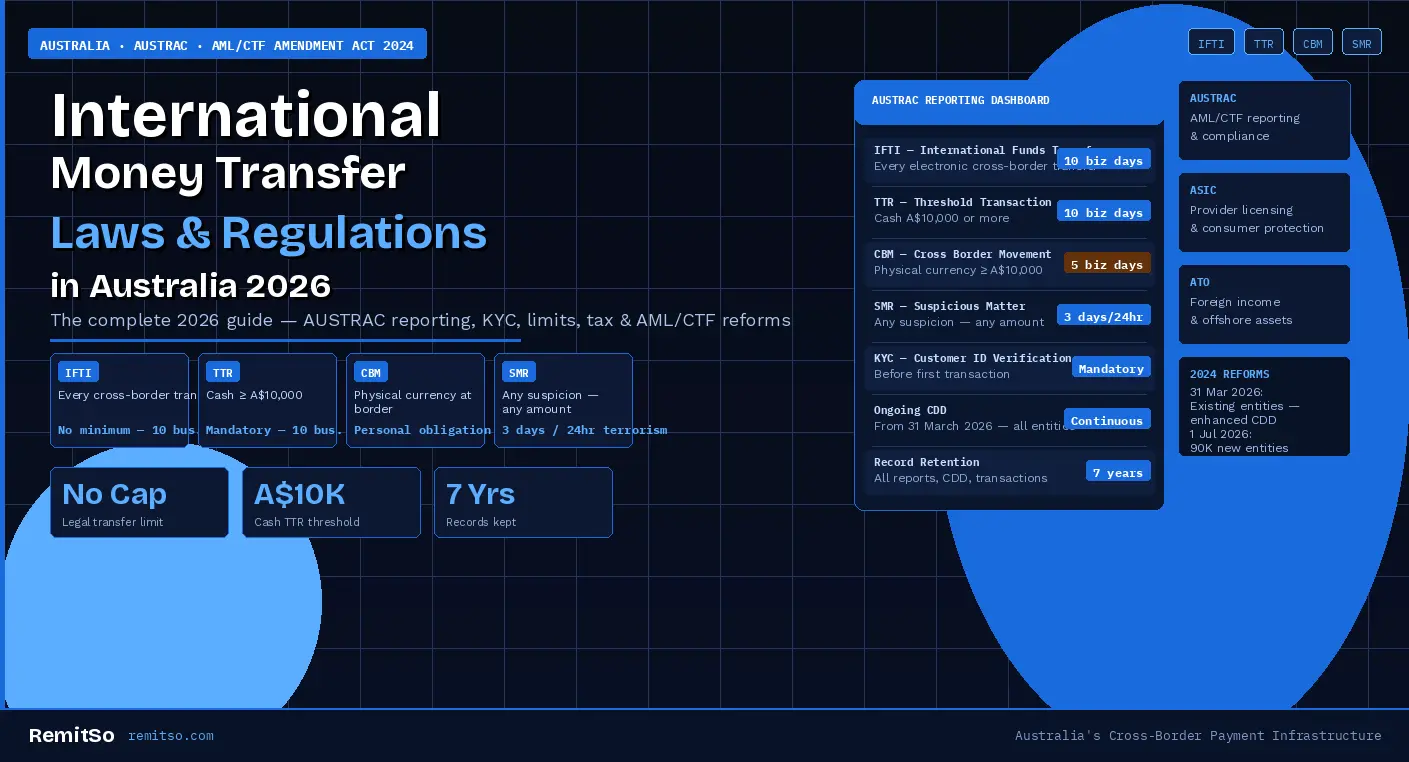
Whether you are sending money to family abroad, paying an overseas supplier, or operating a remittance business in Australia — the rules governing international money transfers apply to you. Australia has one of the world's most comprehensive regulatory frameworks for cross-border payments, administered primarily by AUSTRAC (the Australian Transaction Reports and Analysis Centre) under the Anti-Money Laundering and Counter-Terrorism Financing Act 2006 and its landmark 2024 amendments. In 2026, those rules are more extensive, more enforced, and more consequential than at any previous point in Australia's financial history. This guide explains everything you need to know — from what you must report, when, and to whom, to how much you can send, what documentation providers will ask for, and what the Australian Taxation Office requires when money moves across borders.
In This Article
International money transfers in Australia sit at the intersection of three regulatory frameworks. AUSTRAC is the primary regulator — it administers the Anti-Money Laundering and Counter-Terrorism Financing Act 2006 (AML/CTF Act) and oversees all reporting entities involved in cross-border payment services. The Australian Securities and Investments Commission (ASIC) regulates the licensing of financial services providers, including money transfer operators that hold an Australian Financial Services Licence. The Australian Taxation Office (ATO) sits at the third corner — it is not an AML/CTF regulator, but it has an interest in international transfers as potential indicators of unreported foreign income, capital gains, or offshore assets.
For individuals sending money overseas, AUSTRAC's rules operate in the background — applied by the provider you use, not directly imposed on you as the sender. You do not file reports with AUSTRAC yourself. But you will feel AUSTRAC's requirements through the identity verification your provider asks for, the documentation requests that accompany large or unusual transfers, and the questions about the purpose and source of funds for transfers that fall outside routine patterns. Understanding why providers ask these questions — and what legal framework sits behind them — helps you navigate the process smoothly rather than being caught off guard.
Figure 1: Three regulatory bodies that govern international money transfers in Australia — their roles, jurisdictions, and what they require from senders and providers
AUSTRAC's reporting framework for international money transfers operates through four distinct report types. These are obligations imposed on regulated providers — not on individual senders — but every report filed contains information about the sender, the recipient, and the transaction. Understanding what each report captures, when it is triggered, and what happens to the information helps both individuals and businesses understand the regulatory environment they are operating within.
| Report Type | Full Name | Trigger | Deadline | Filed By |
|---|---|---|---|---|
| IFTI | International Funds Transfer Instruction | Every electronic transfer in or out of Australia — no minimum amount | Within 10 business days | Your provider — automatically |
| TTR | Threshold Transaction Report | Cash component of A$10,000 or more (single transaction or linked series) | Within 10 business days | Your provider — automatically |
| CBM | Cross Border Movement Report | Physically carrying or shipping A$10,000 or more in currency or bearer instruments across Australian border | Within 5 business days | You — the individual carrying the funds |
| SMR | Suspicious Matter Report | Suspicion of ML, TF, or proceeds of crime — any amount | 3 business days (24 hrs for TF) | Your provider — based on monitoring |
Figure 2: Australia's four international transfer reporting obligations — triggers, deadlines, and who is responsible for filing each report with AUSTRAC
The IFTI reporting obligation is the one most Australians are unaware of — and it is the most comprehensive of the four. Unlike the TTR, which is triggered by a cash amount threshold, an IFTI must be reported for every single electronic transfer of funds across Australia's border, regardless of the amount. A $50 remittance to family in the Philippines generates an IFTI report. A $500,000 business payment to a supplier in Germany generates an IFTI report. The amount is irrelevant — the cross-border electronic transfer is the trigger.
IFTI reports must include the sender's and recipient's details, the originating and destination financial institutions, the transfer amount and currency, and the value date. AUSTRAC uses IFTI data as one of its primary financial intelligence tools — the dataset enables pattern analysis across the entire Australian cross-border payments market, allowing the regulator and law enforcement agencies to identify emerging ML/TF typologies, track funds flows to high-risk jurisdictions, and benchmark individual operator behaviour against sector norms. When AUSTRAC conducts an examination of a remittance operator, IFTI data is one of the primary datasets against which the operator's internal monitoring and SMR filing history is compared.
While IFTI, TTR, and SMR obligations fall on regulated providers, the CBM report is the one obligation that falls directly on individuals. If you carry or ship physical currency or bearer negotiable instruments — including cash, traveller's cheques, or money orders — valued at A$10,000 or more across Australia's international border, you must report this to the Australian Border Force within five business days. The obligation applies whether you are taking money out of Australia or bringing money into Australia. Failure to report, or providing false information in a CBM report, is a criminal offence. This is not a theoretical risk — the Australian Border Force actively detects unreported cash movements at international airports and seaports, and undeclared currency above the threshold is subject to seizure.
Know Your Customer (KYC) requirements are the identity verification obligations that every Australian money transfer provider must satisfy before processing a transaction. These are not provider preferences or terms-of-service conditions — they are legal requirements imposed by the AML/CTF Act. Providers that fail to conduct adequate customer identification and verification are in breach of their AUSTRAC obligations and face significant penalties.
For individuals, the standard KYC process requires verification of full legal name, date of birth, and residential address. Providers verify this information through one or more of the following: a current Australian passport, Australian driver's licence, Medicare card, or a combination of secondary documents. Most modern digital providers verify identity electronically through credit header data and government identity databases — meaning the process is completed online in minutes without the need to present physical documents. For larger transfers, particularly those exceeding $10,000 AUD or going to high-risk jurisdictions, enhanced verification may be required, including documentation of the source of funds.
Figure 3: Standard KYC identity verification requirements for individual and business senders under AUSTRAC's AML/CTF framework
There is no legal maximum on how much money an individual or business can send internationally from Australia. Australian law does not impose a cap on the amount that can be transferred overseas. The common misconception that transfers above $10,000 are "blocked" or "illegal" is incorrect — the $10,000 threshold triggers a reporting obligation for cash transactions, not a prohibition on transfers of that size. You can send $100,000, $1 million, or more overseas from Australia, provided you use a properly licensed provider and comply with their identity verification and documentation requirements.
Figure 4: Australia's international transfer limits — what the law actually says vs common misconceptions about the $10,000 threshold
What does vary by provider are operational limits — the maximum transfer sizes, daily limits, and weekly caps that individual banks and money transfer operators impose based on their own risk management policies, technology infrastructure, and the verification level of your account. A bank may allow unlimited international transfers for a fully verified business account while capping daily outbound transfers for a new individual account at $5,000 until additional verification is completed. A specialist digital remittance provider may have higher operational limits but require enhanced verification for transfers above certain thresholds. These limits are contractual, not legal — and they can typically be raised by completing additional identity verification or providing documentation about the purpose and source of large transfers.
For routine transfers at amounts consistent with your established profile — regular family remittances, recurring business payments, modest personal transfers — most providers will process your transaction with the standard identity verification already on file. But for large, unusual, or first-time transfers to new destinations, your provider is legally required under the AML/CTF Act to understand the source of the funds being transferred and the purpose of the payment. This is part of their ongoing Customer Due Diligence (CDD) obligation.
Documentation commonly requested for larger international transfers includes recent bank statements showing the origin of the funds being transferred, payslips or employment contracts for transfers funded from employment income, settlement statements for property sales, inheritance documents for estate distributions, business invoices or contracts for commercial payments, and investment account statements for transfers of investment proceeds. The specific documentation required depends on the transfer size, the destination jurisdiction, and how the transfer compares to your established pattern with that provider. Transfers to FATF-greylisted or high-risk jurisdictions will trigger enhanced documentation requirements even at lower amounts.
The Anti-Money Laundering and Counter-Terrorism Financing Amendment Act 2024 — passed by the Australian Parliament on 29 November 2024 and receiving Royal Assent on 10 December 2024 — represents the most transformational change to Australia's financial crime framework since the original AML/CTF Act commenced in 2006. For anyone sending or receiving international money transfers, and for every business involved in cross-border payments, the 2024 reforms matter in 2026 in several specific and practical ways.
Figure 5: Four key changes under Australia's AML/CTF Amendment Act 2024 that affect international money transfers from 2026 onwards
International money transfers are not themselves taxable in Australia. Sending $10,000 to a family member overseas does not trigger an income tax liability. Receiving $10,000 from abroad does not automatically create a taxable event. The act of transferring money internationally is tax-neutral — what matters to the ATO is the nature and origin of the money being transferred, not the transfer itself.
Income generated from overseas sources — foreign employment income, foreign business income, foreign investment returns, foreign rental income, and foreign pension payments — is taxable in Australia if you are an Australian tax resident, regardless of whether that income is transferred to Australia or left in an overseas account. The ATO requires that foreign-sourced income be declared in your Australian tax return in the income year it is earned, not when it is remitted to Australia. Receiving a large overseas bank transfer that represents accumulated foreign income does not create the tax liability — that liability arose when the income was earned. But the receipt of the transfer may prompt ATO enquiries about whether the underlying income was properly declared.
Every regulated provider in Australia — whether a major bank or a specialist remittance operator — is subject to the same AUSTRAC reporting obligations for international transfers. The IFTI report is filed whether the transfer is sent through Commonwealth Bank or through a digital remittance platform. The difference between providers is not in their regulatory obligations — it is in how they implement compliance, what they charge, and how fast they process transfers.
| Factor | Australian Banks | Specialist Remittance Providers |
|---|---|---|
| Exchange rates | Mid-market rate plus significant markup — typically 2–4% above interbank rate | Rates closer to mid-market — specialist providers compete on exchange rate margin |
| Transfer fees | A$15–$35 per international transfer — plus correspondent bank fees at receiving end | Lower or zero flat fees — revenue model based on exchange rate spread |
| Processing time | 1–5 business days — longer for exotic corridors | Same day to 24 hours for most major corridors — real-time for some |
| AUSTRAC compliance | Same obligations — IFTI, TTR, SMR, KYC | Same obligations — IFTI, TTR, SMR, KYC |
| Transfer limits | Often higher for existing account holders — lower for new customers | Verification-based — higher limits available with enhanced KYC |
| Corridor coverage | Major corridors well-covered — niche corridors may use correspondents | Specialists often deeper in specific corridors — better rates for those routes |
Figure 6: Banks vs specialist remittance providers for international transfers from Australia — key differences in cost, speed, and service
The most important practical point for Australian senders comparing providers is that every licensed provider files the same AUSTRAC reports — your transfer is visible to AUSTRAC regardless of which channel you use. The choice of provider affects cost, speed, and user experience, not regulatory visibility. What it also affects is compliance quality: a well-run specialist remittance provider with strong AML controls and clear documentation processes will typically provide a smoother experience for large or complex transfers than one whose compliance infrastructure is underdeveloped. An AUSTRAC-regulated provider with robust compliance is also less likely to unexpectedly freeze your funds mid-transfer due to a compliance intervention.
For businesses operating in Australia's cross-border payments market — whether launching a new remittance service, expanding an existing MSB operation, or scaling a fintech payments platform — the regulatory infrastructure required to operate compliantly under AUSTRAC is substantial. IFTI reporting for every transaction, ongoing KYC and CDD obligations, risk-based transaction monitoring, SMR filing workflows, and seven years of audit-grade record retention are all baseline requirements, not optional enhancements.
RemitSo's Remittance as a Service (RaaS) platform for Australia is built to operate within this regulatory environment as a foundation, not an add-on. Banks, neo-banks, fintechs, credit unions, exchange houses, and money services businesses across Australia use RemitSo's infrastructure to process compliant cross-border payments with the reporting, monitoring, and documentation capabilities that AUSTRAC examinations require. If you are building or scaling a cross-border payments business in Australia and want the compliance architecture in place from day one, RemitSo is designed for exactly that requirement.
The transfer itself does not need to be declared to the ATO — sending or receiving money internationally is not a taxable event. However, if the money being transferred represents taxable income, you need to declare that income in your Australian tax return in the year it was earned. This applies to foreign employment income, foreign business income, foreign rental income, and foreign investment returns — all of which are assessable in Australia for Australian tax residents regardless of whether the money is ever brought to Australia. If you receive a large international transfer that represents accumulated foreign income, the ATO may enquire about whether that income was declared in prior years. For inheritances, gifts, and transfers of previously taxed capital, the transfer is generally not taxable — but it is good practice to have clear documentation explaining the nature of the funds in case questions arise from either AUSTRAC (through your provider) or the ATO.
Every electronic international transfer from Australia is reported to AUSTRAC regardless of the amount — there is no threshold below which international transfers are exempt from IFTI reporting. Your provider files an International Funds Transfer Instruction report for every cross-border electronic transfer, whether it is $50 or $500,000. The $10,000 threshold that is commonly cited relates specifically to cash transactions and triggers a separate Threshold Transaction Report — but it does not set a lower limit on reporting for international electronic transfers. There is also no legal maximum on how much you can send overseas — Australia does not impose a cap on outbound international transfers. Provider-imposed limits are contractual, not legal, and can typically be raised with additional identity verification.
A Cross Border Movement report is a report you — not your provider — must file with the Australian Border Force when you physically carry or ship currency or bearer negotiable instruments valued at A$10,000 or more across Australia's international border. This applies to both inbound and outbound physical currency movements. The report must be filed within five business days of the movement. The obligation covers Australian dollars, foreign currencies, and bearer negotiable instruments such as traveller's cheques, money orders, and bank drafts. The threshold applies to the total value of all currency and instruments combined at the prevailing exchange rate — not to Australian dollars alone. Failure to file a CBM report is a criminal offence, and the Australian Border Force has the power to seize unreported currency above the threshold. Unlike IFTI and TTR reports (which are filed by your provider), the CBM is your direct, personal obligation if you are physically transporting the funds.
Your provider is legally required under Australia's AML/CTF Act to understand the source of funds for large, unusual, or high-risk transfers as part of their Customer Due Diligence obligations. This is not discretionary — it is a regulatory requirement that applies to every licensed provider in Australia. The obligation is triggered by factors including the size of the transfer relative to your established profile, the destination jurisdiction (higher-risk countries require more scrutiny), the payment method (cash-funded transfers attract higher scrutiny than bank-funded transfers), and whether the transfer is unusual compared to your transaction history with that provider. Refusing to answer source of funds questions or providing inconsistent explanations can result in your transfer being declined, your account being reviewed, and potentially a Suspicious Matter Report being filed with AUSTRAC. Providing clear, accurate documentation — a bank statement, payslip, settlement statement, or similar — resolves the question quickly and enables your transfer to proceed.
No — there is no legal prohibition on sending large sums of money internationally from Australia, and no legal maximum on the amount you can transfer. What changes as amounts increase is the documentation and verification requirements your provider applies, and the likelihood that your provider will ask for source of funds documentation before processing the transfer. Large transfers are not illegal — they attract more scrutiny because they represent higher ML/TF risk if the source of funds is illicit. Provided the funds are legitimately sourced, properly documented, and your provider's KYC verification is complete, a large international transfer is entirely legal and processed in the ordinary course. Where transfers become illegal is when they involve proceeds of crime, are structured to avoid reporting obligations, are sent to sanctioned individuals or entities, or are made with false or misleading information provided to the provider.
AUSTRAC — the Australian Transaction Reports and Analysis Centre — is Australia's financial intelligence unit and AML/CTF regulator. It administers the Anti-Money Laundering and Counter-Terrorism Financing Act 2006 and regulates all businesses that provide designated financial services, including banks, remittance operators, foreign exchange dealers, and digital payment providers. When you make an international transfer, AUSTRAC is not directly involved in your transaction — but your provider is required to report that transfer to AUSTRAC through an IFTI report, to monitor your transaction patterns for suspicious activity, and to file a Suspicious Matter Report if anything about your transfer or behaviour gives rise to a suspicion of money laundering or terrorism financing. AUSTRAC uses the data it collects to generate financial intelligence for law enforcement agencies including the Australian Federal Police, the ACIC, and national security agencies. AUSTRAC does not freeze individual transactions or block transfers directly — but its intelligence can inform law enforcement action that results in funds being restrained.
The AML/CTF Amendment Act 2024, passed in November 2024 and progressively effective from March 2026, makes the most significant changes to Australia's financial crime laws in nearly two decades. For individuals sending money overseas, the most visible change is that providers are required to apply stronger ongoing Customer Due Diligence — meaning your provider may re-verify your identity or ask updated source of funds questions even for an account you have held for years, particularly if your transfer patterns change. For the broader payments ecosystem, the Act expands AUSTRAC's regulated population to approximately 90,000 additional businesses from 1 July 2026 — including lawyers, accountants, and real estate agents who facilitate property transactions involving international funds. The Act also moves Australia toward implementing the FATF Travel Rule, which will require that originator and beneficiary information travels with cross-border electronic transfers through every step of the payment chain, significantly enhancing the traceability of international money flows.
Every licensed international money transfer provider in Australia is subject to the same AUSTRAC regulatory obligations — the compliance framework is the same regardless of which provider you choose. The meaningful differences between providers are cost, speed, corridor coverage, and the quality of their compliance processes. On cost: compare the total cost of transfer — exchange rate margin plus fees, not fees alone. A provider charging zero fees but applying a 3% exchange rate markup on a $10,000 transfer costs you $300 in the rate alone. On speed: major corridors are typically same-day or next-day with specialist providers, slower with banks. On compliance quality: a provider with strong, well-functioning AML controls will ask clearer questions, process documentation faster, and be less likely to unexpectedly delay or block your transfer mid-process. Check that your provider is enrolled with AUSTRAC as a reporting entity — AUSTRAC publishes a register of reporting entities — and holds an Australian Financial Services Licence (AFSL) or is an authorised representative of an AFSL holder where required for the services they provide.