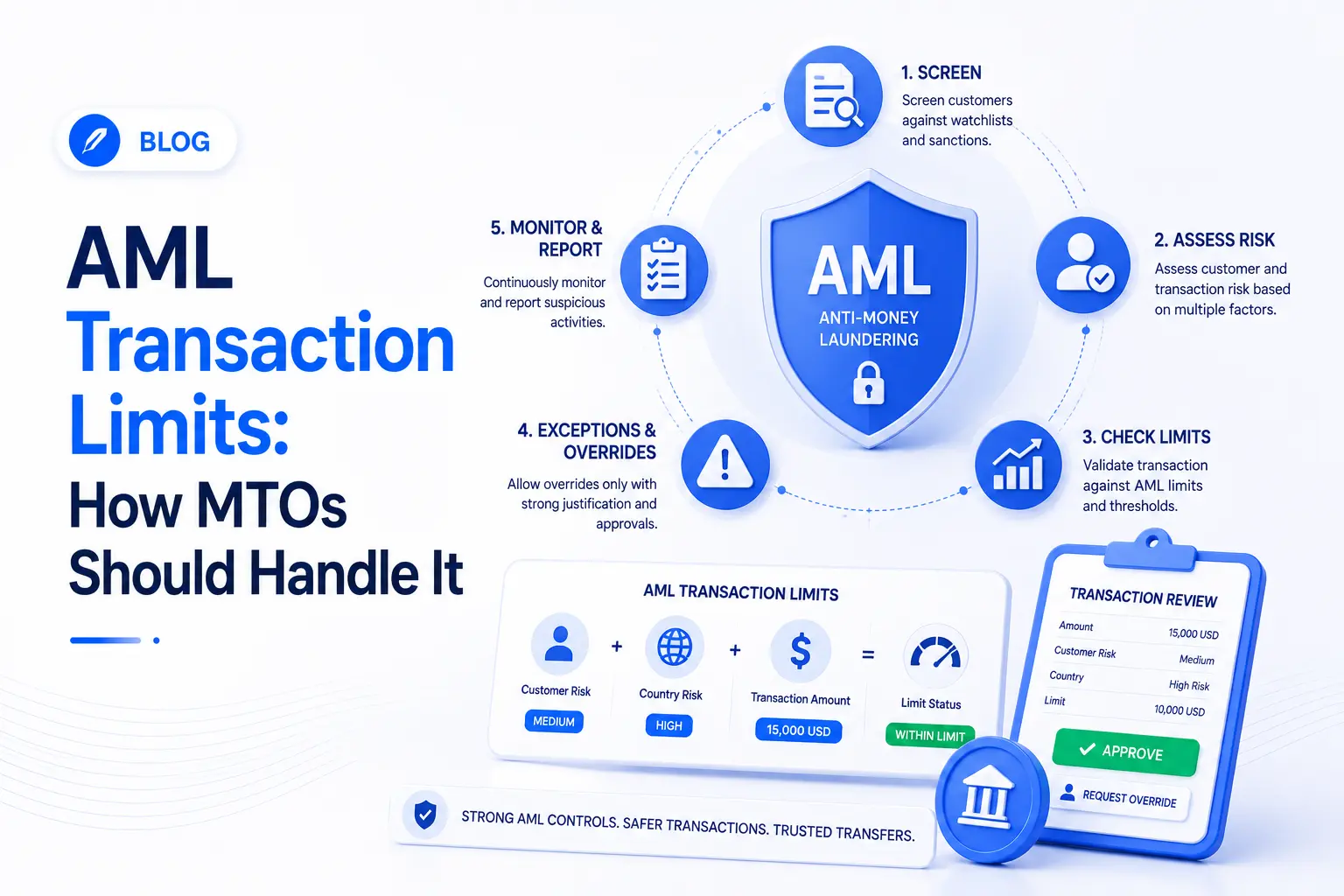
Strong audit logs help MTOs prove what changed, when it changed, who made the change, and what the previous and new values were.
For a Money Transfer Operator (MTO), compliance is not only about having AML policies, transaction limits, sanctions screening, and customer risk controls in place. It is also about being able to prove what happened, when it happened, who made the change, and why the resulting state exists. This is where audit logs become an important part of the compliance technology layer.
In This Article
An audit log is a chronological record of significant actions performed within a remittance system. Depending on the platform, these events can relate to customers, transactions, AML controls, KYC workflows, sanctions screening, administration, permissions, and other operational configuration.
Typical audit events can include:
The purpose is not simply to record activity. The purpose is to create a reliable historical trail that allows an organisation to reconstruct important events later.
For a regulated remittance business, that distinction matters. A compliance reviewer may need to determine not only whether a customer's transaction limit was changed, but also what the previous limit was, what the new limit became, which period it applied to, and when the change occurred.
Consider a customer whose transaction limit is changed twice.
If both audit records only say “Customer transaction limit was updated”, the history becomes difficult to interpret.
The reviewer knows that two changes occurred, but not:
A stronger audit trail preserves the state transition.
Now the audit history tells a connected story instead of simply listing two generic events.
Compliance controls are only useful when an organisation can demonstrate how they were applied and how important changes were controlled.
Suppose a customer has an AML transaction limit override. A compliance reviewer may ask:
The audit history should help establish a clear relationship between the policy and the customer-specific change:
This creates traceability between the platform's configured control and the individual customer's treatment.
Without this information, a reviewer may need to rely on screenshots, database records, administrator explanations, or other disconnected evidence. A properly designed audit log can significantly reduce that dependency.
Transaction limits are particularly important because they can directly affect how a remittance platform applies AML controls.
An MTO may have standard thresholds based on:
There may also be situations where an authorised user applies a customer-specific override.
That override should not simply replace the existing value without preserving what was there before.
| Audit Detail | Recorded Value |
|---|---|
| Limit period | Past 30 days |
| Limit before | CAD 10,000 |
| Limit after | CAD 15,000 |
Months later, this record still explains what happened without requiring someone to reconstruct the previous state from another system.
One of the most important principles of a useful audit trail is recording the state transition, rather than only the final state.
The new value tells you where the system ended up. The old value tells you what changed.
If the limit is changed again:
The two events now form a connected sequence. This is much more useful than simply knowing that the current limit is CAD 20,000.
Give your MTO operations team clearer visibility into customer changes, AML controls, administrative actions, and compliance-related events.
A common mistake in audit design is assuming that the current customer configuration is enough.
It is not.
The current value tells you what the system looks like now. An audit log should tell you how it got there.
If a customer currently has a CAD 20,000 transaction limit, that does not tell an auditor whether:
Historical audit data fills that gap.
This is why audit logs should generally be treated as a historical record rather than simply another view of the current database state.
Audit logs are often displayed in multiple places. A detailed customer audit drawer may contain additional information, while a global audit listing may show only the event description.
This creates an important design requirement:
The second description immediately tells the reviewer which policy period was affected.
Structured details can then provide:
This makes the audit event useful both in a summary listing and in a detailed review.
Financial values without currencies are ambiguous.
For a remittance platform operating across multiple markets, recording:
is not sufficient.
The audit record should make clear whether the amount was:
Including the currency directly in the audit details prevents ambiguity and makes the record easier to review independently of the application's current currency settings.
This becomes especially important when compliance teams, auditors, or operations teams review historical records at a later date.
Audit logs can make internal compliance investigations more efficient by allowing reviewers to reconstruct relevant changes directly from the platform.
Consider a compliance officer reviewing an unusually high customer transaction volume. They may need to determine:
If the audit trail contains these details, the reviewer can reconstruct the relevant history without switching between multiple disconnected sources.
This reduces manual investigation and can make compliance reviews more consistent.
When a remittance business is reviewed by an auditor or regulator, the question is often not simply whether an AML policy exists.
Reviewers may also need to understand how controls were applied and how changes were controlled.
A well-designed audit trail can provide evidence of:
The audit log therefore becomes part of the evidence supporting the organisation's operational controls.
Another important principle is preserving the integrity of historical audit events.
Suppose an audit-log enhancement is introduced today, but older records were created before the system captured before-and-after values.
The platform should not invent missing information later simply to make the old event look like a newer event.
If the system did not capture the before and after values at the time, those values should not be fabricated later.
This preserves the integrity of the historical record while allowing the platform to improve its auditability over time.
AML compliance is not only about policies and procedures. It also depends on the technology used to enforce, monitor, and document those controls.
A mature remittance platform should therefore consider auditability across multiple operational areas.
The objective is to create a connected history of important compliance events rather than isolated records spread across different parts of the platform.
A useful audit event should answer five fundamental questions.
Which user, administrator, service, or system performed the action?
What exactly changed or what action was performed?
When did the action occur?
What was the previous state and what is the new state?
Where applicable, what policy, workflow, approval, or reason was associated with the change?
Not every event needs exactly the same fields. A KYC action, a transaction-status change, and an AML limit override may require different contextual information. What matters is that each event contains the information necessary to understand its significance.
Imagine an MTO has a standard 30-day transaction threshold of:
An authorised administrator applies a customer-specific override:
The audit record could show:
| Audit Field | Recorded Information |
|---|---|
| Action | Transaction limit updated |
| Limit period | Past 30 days |
| Currency | CAD |
| Limit before | CAD 10,000 |
| Limit after | CAD 15,000 |
Later, the administrator changes the limit again:
The second event records the same relevant context:
Now the customer's audit history provides a clear sequence of changes. This is significantly more useful than two identical entries stating only that the limit was updated.
If detailed information appears only inside a specific screen but the global audit listing shows an incomplete description, important context can be lost during review.
The audit event should remain understandable wherever it is presented.
Audit logs are often treated as a secondary feature: something added after the core workflow is already built.
For regulated financial platforms, that approach can create problems.
A better approach is to design auditability alongside the compliance workflow itself.
That question often reveals the information that should be captured at the moment the event occurs.
For AML limit overrides, that means preserving the policy period and before-and-after values. For other events, the critical information may be different.
The broader principle remains the same:
A useful audit architecture should capture an event at the point where an important action occurs and preserve the relevant context as part of the historical record.
Figure 1: Action → Event Identification → Context → Before/After Values → Audit Event → Historical Preservation → Review → Demonstrable Control.
The objective is not to record every technical event generated by the system. It is to preserve the events that matter for operational accountability, compliance review, and historical traceability.
Give your compliance and operations teams a clearer historical view of the changes that affect customers, AML controls, transactions, and administration.
For remittance businesses, having compliance controls is only part of the operational requirement. The platform also needs to provide visibility into how those controls are applied and changed.
RemitSo's remittance management platform supports MTO operations across customer management, KYC, AML controls, transaction processing, and administrative workflows, helping businesses build greater visibility into their remittance operations.
As audit requirements evolve, detailed event-level information becomes increasingly important for understanding customer and compliance-related changes.
The objective is not simply to create more records. It is to create records that remain useful when a compliance officer, auditor, operations manager, or administrator needs to understand what happened months after the original event.
An audit log is a chronological record of important actions and changes performed within a remittance platform. Depending on the system, it can include customer changes, AML controls, transaction actions, KYC events, administrative changes, and other compliance-related activity.
Audit logs help create a traceable history of how compliance controls and customer-related decisions were applied. They can help reviewers understand what changed, when it changed, and what the relevant previous and new values were.
A strong audit event should capture the responsible user or system, the action performed, when it occurred, the affected record or control, and relevant before-and-after values. Depending on the event, currency, policy period, reason, or workflow context may also be important.
The before value shows the state that existed before the change, while the after value shows the resulting state. Together they establish the state transition and allow reviewers to understand exactly what changed.
Yes, when the event involves a financial amount, recording the currency helps prevent ambiguity. A value such as 10,000 is incomplete without knowing whether it represents CAD, USD, or another currency.
Missing historical information should not be fabricated. Older records can remain in their original form, while new events capture richer information going forward. This helps preserve the integrity of the historical audit trail.
Detailed audit logs can help compliance teams reconstruct customer changes, AML overrides, administrative actions, and other important events. This can reduce manual investigation and make it easier to understand how a customer or transaction reached its current state.