The complete guide to licensing, compliance, technology, and revenue models for travel agencies and foreign exchange businesses entering the remittance market.
Thousands of travel agencies already handle foreign currency exchange, international travellers, and cross-border financial transactions every day. Expanding into remittance services is a natural next step that creates recurring revenue, increases customer retention, and transforms a seasonal travel business into a year-round financial services operation. This guide explains how travel agencies and forex businesses can legally launch remittance services in 2026 — covering the licenses required, how compliance works, technology options, revenue models, and how white-label platforms like RemitSo significantly reduce the time and cost of entering the market.
Travel agencies have spent years building exactly the customer relationships that remittance businesses need most. International travellers, overseas students, migrant workers, businesses with cross-border suppliers, medical tourists — these customers already walk through the doors of travel agencies and forex businesses daily. The difference is that right now, when those customers need to send money abroad, most travel agencies refer them elsewhere. This guide is for the businesses that want to stop referring and start offering — and want to understand exactly what licensing, compliance, technology, and operational structure that requires in 2026.
In This Article
For years, travel agencies have helped customers with foreign currency exchange, international travel bookings, visa assistance, overseas education payments, travel insurance, international business travel, and holiday packages — services that naturally attract customers who also need to send money abroad. Parents sending money to children studying overseas, migrant workers supporting families back home, tourists pre-paying hotels, businesses settling international supplier invoices, medical travellers making hospital deposits, and international freelancers receiving earnings are all walking through travel agency doors today. The question is not whether these customers exist. They do. The question is whether a travel agency captures that transaction or hands it to a bank or a standalone money transfer operator down the street.
This is the commercial logic behind travel agency diversification into remittance: the customer acquisition cost is already paid. The customer is already in the relationship. Adding remittance services creates a complete international financial service under one roof, rather than a partial one that sends customers elsewhere for the financial leg of their cross-border journey.
The travel industry experiences seasonal demand — peak holiday periods, summer travel, school-year breaks — with corresponding troughs. Remittances do not follow the same pattern. People send money abroad every day for family support, education, medical expenses, salaries, investments, property purchases, and business payments, regardless of whether it is a peak travel season. This counter-cyclicality is one of the strongest strategic arguments for travel agencies adding remittance services: it creates recurring monthly revenue that flows even when the travel booking calendar is quiet.
Beyond smoothing seasonal revenue, remittance services increase customer lifetime value, create natural cross-sell opportunities between forex, travel, and money transfer products, and improve customer loyalty by making the agency the single point of contact for the customer's international financial life. For many agencies that have made this transition, remittance revenue eventually exceeds ticketing revenue — not because ticketing declines, but because the frequency and consistency of remittance transactions compound over a loyal customer base in a way that one-time booking fees cannot.
Foreign exchange businesses already possess most of the operational capabilities that remittance requires. Many regulators recognise this overlap and allow licensed forex operators to expand into money transfer by obtaining additional approvals rather than starting from scratch — because the compliance infrastructure is already largely in place.
| Existing Forex Capability | How It Benefits Remittance |
|---|---|
| Currency exchange operations | Enables competitive FX pricing for remittance customers from day one |
| AML procedures and policies | Reduces compliance build time — adapt existing controls rather than create them |
| Customer verification (KYC) | Simplifies onboarding — existing identity checks often satisfy remittance requirements |
| International banking relationships | Faster access to payment corridors and settlement accounts |
| Cash and multi-currency management | Directly applicable to remittance settlement and float management |
| Compliance staff and training | Lower incremental operational cost compared to a greenfield MTO |
Figure 1: How existing forex business capabilities map to remittance operational requirements — the compliance and banking infrastructure overlap is substantial.
Yes — but only after obtaining the required licenses or operating under an existing licensed entity. Regulatory requirements differ significantly by country, and offering money transfer services without the appropriate authorisation carries serious regulatory and criminal consequences. Some jurisdictions allow travel agencies and forex businesses to offer remittance through an agency or sub-agent agreement with a licensed MTO, while others require the business to hold its own full Money Transfer Operator license. The table below shows the typical regulator by jurisdiction as a starting reference — always verify current requirements directly with the relevant authority before beginning any application or service launch.
| Country / Region | Typical Regulator |
|---|---|
| Australia | AUSTRAC |
| Singapore | Monetary Authority of Singapore (MAS) |
| United Kingdom | Financial Conduct Authority (FCA) |
| Canada | FINTRAC |
| United States | FinCEN + State Money Transmission Licenses |
| UAE | Central Bank of the UAE |
| Europe | National financial regulators (under EU PSD2 / AMLD framework) |
Figure 2: Remittance licensing regulators by key market. Requirements vary significantly — always confirm current rules with the relevant authority.
Travel agencies and forex businesses entering remittance have two distinct operating models to consider, each with different cost, compliance, and revenue implications. The right choice depends on the size of the business, available capital, long-term ambitions, and regulatory environment in the target market.
Option 1: Become an Authorized Agent. This is the fastest and lowest-cost entry route. The business operates under an existing licensed MTO, using that MTO's regulatory permissions, compliance framework, and payment infrastructure. Startup costs are lower, the launch timeline is shorter, compliance obligations are shared with the principal MTO, and no significant technical infrastructure needs to be built. It is well-suited to single-location businesses, smaller travel agencies, and new market entrants who want to test remittance demand before committing to full licensing. The trade-off is margin: as an agent, the business earns a commission from the MTO rather than keeping the full spread.
Option 2: Obtain Your Own MTO License. This model gives the business full operational and commercial control — its own regulatory permissions, compliance programme, pricing strategy, brand, and technology platform. Margins are significantly higher because the business retains the full FX spread and transfer fee rather than receiving an agent commission. This route also unlocks the ability to expand into new corridors, launch digital channels, add corporate customers, and build a brand that compounds in value over time. The investment requirement is greater — licensing, compliance build-out, banking relationships, and technology all require upfront commitment — but the long-term return is substantially higher for businesses with the capital and ambition to pursue it.
Depending on the jurisdiction and operating model, businesses typically need one or more of the following authorisations: a Money Transfer License, Money Services Business (MSB) registration, Payment Institution License, Electronic Money Institution (EMI) License (common in Europe), Foreign Exchange License, AML registration, or Financial Intelligence Unit registration. Additional approvals may apply if the business plans to offer cross-border payments via mobile wallets, digital banking, or stored-value accounts.
Beyond licensing, ongoing compliance is non-negotiable. Remittance is one of the world's most heavily regulated industries, and the compliance obligations are continuous rather than one-time. At a minimum, businesses must implement Customer Identification (KYC) to verify customer identity before processing transactions, AML monitoring to detect suspicious activity in transaction flows, sanctions screening to check customers against global watchlists, transaction monitoring to identify unusual payment patterns, structured recordkeeping in line with regulatory retention requirements, and a process for submitting Suspicious Transaction Reports (STRs) when required. Failure to maintain these controls — not just implement them once — can result in substantial penalties, licence revocation, and reputational damage that is very difficult to recover from in a trust-dependent industry.
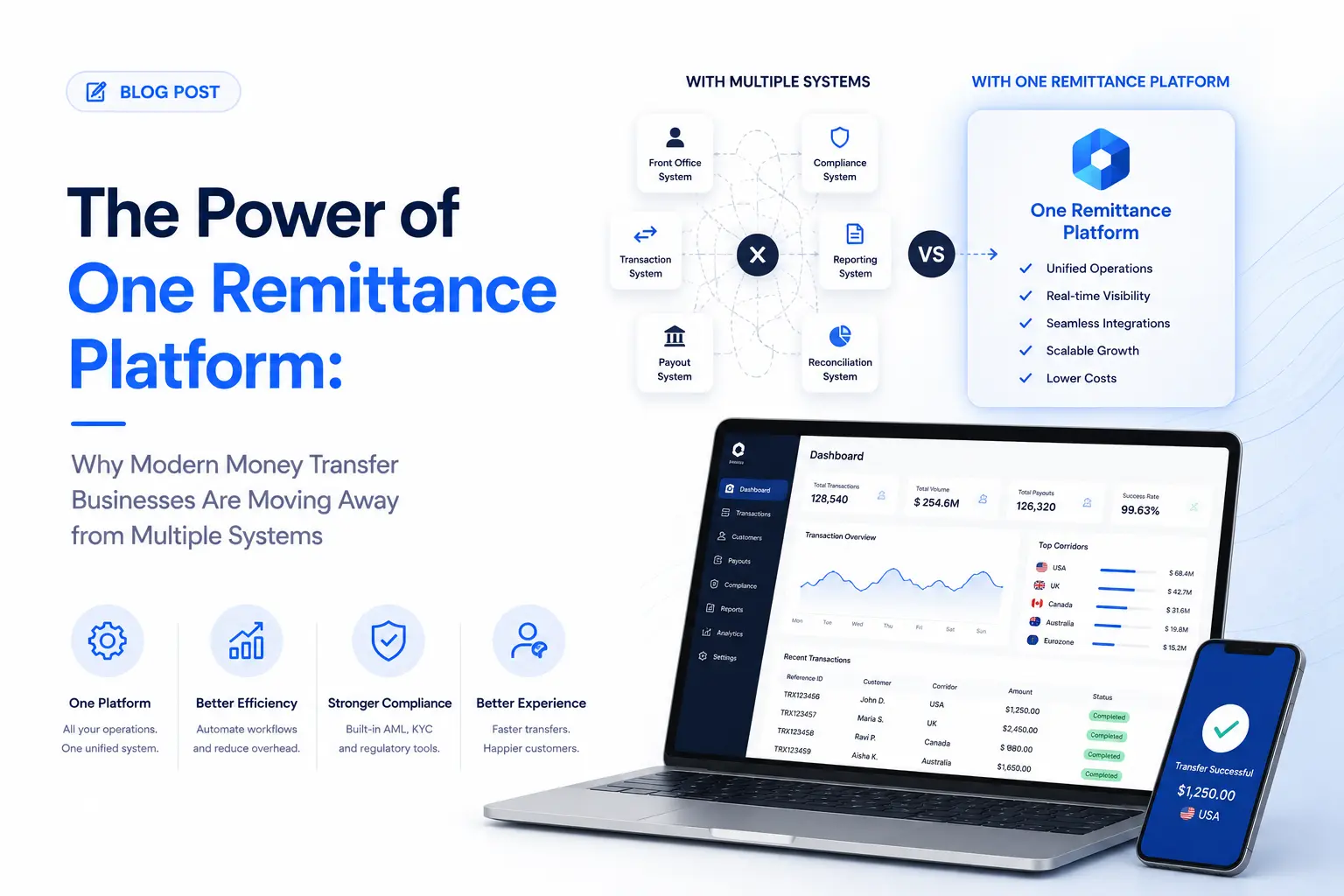
Modern remittance businesses require significantly more than a payment gateway. A complete operational platform covers customer onboarding, KYC verification, AML screening, sanctions screening, transaction monitoring, multi-currency wallets, exchange rate management, payout partner integrations, banking APIs, agent management, mobile applications, a web portal, admin dashboard, settlement engine, accounting, reporting, and compliance workflows. Building all of this internally from scratch can take years and requires a large team of developers, compliance specialists, security engineers, and banking relationship managers working in parallel.
For most travel agencies and forex businesses entering remittance, the more practical path is a white-label remittance platform — pre-built infrastructure that can be configured and branded for the specific business rather than rebuilt from zero.
A common misconception among new market entrants is that remittance revenue comes only from transfer fees. In practice, established remittance businesses generate income across multiple streams simultaneously. Transfer fees are one component. Foreign exchange margins — the spread between the wholesale rate and the customer rate — are often the larger contributor. Corporate payment services, payroll solutions, bill payments, international tuition payments, merchant settlements, currency exchange, API services, and subscription-based corporate accounts all represent additional revenue lines that can be layered onto the core transfer business as it matures. This diversification is what creates the resilient, recurring revenue model that makes remittance so strategically attractive relative to transaction-based travel booking income.
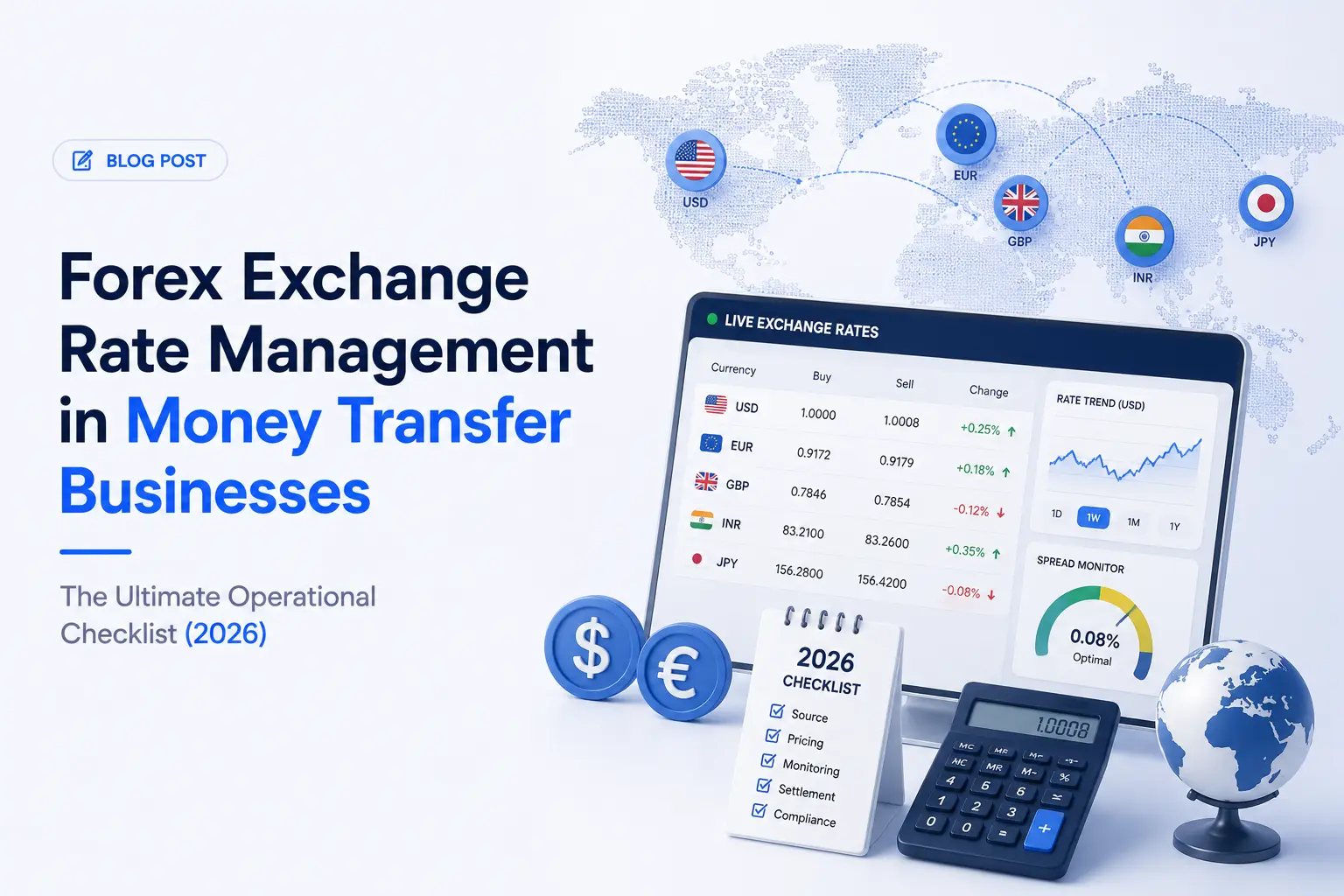
Launching remittance services involves several operational challenges that businesses entering the market for the first time consistently encounter. Regulatory approvals and licensing timelines vary widely by jurisdiction — some markets move quickly, others take twelve to eighteen months. Securing reliable banking partners can be one of the most time-consuming aspects of setup, since correspondent banks have become increasingly selective about the payment businesses they work with. Compliance costs — AML, KYC, and transaction monitoring — require ongoing investment well beyond the initial implementation. Cross-border payments remain a significant target for financial crime, making fraud prevention a continuous operational concern. Foreign exchange volatility requires active treasury management. And connecting to global payout networks is technically complex without an experienced integration partner. Choosing the right technology provider reduces many of these challenges materially, since a well-established platform brings pre-built payout integrations, compliance modules, and banking relationships that would otherwise take years to assemble independently.
Building a money transfer platform from scratch requires large development teams, compliance specialists, banking integrations, security audits, and regulatory expertise — a combination that typically takes years to assemble and costs well beyond what most travel agencies or forex businesses have available for technology investment. White-label platforms offer a structurally different approach: pre-built infrastructure that the business configures, brands, and operates as its own rather than building from zero. A modern white-label remittance platform provides pre-built customer onboarding and KYC, AML and compliance modules, mobile applications, admin dashboards, multi-country payout support, payment APIs, FX management, and agent portals — all deployable in weeks rather than years, and all operating under the business's own brand identity.
The economic case is straightforward: a white-label platform converts what would be a multi-year development capex into a predictable operating cost, with the additional benefit of accessing a platform that is already proven in production rather than carrying the technical risk of a first-generation build.
Instead of spending years developing infrastructure, travel agencies and forex businesses can use RemitSo's white-label remittance platform to accelerate market entry. RemitSo provides white-label web and mobile applications, multi-country remittance support, global payout integrations, AML and KYC modules, transaction monitoring, FX management, agent management, payment orchestration, API integrations, compliance-ready workflows, and scalable cloud infrastructure — covering the full operational stack a new MTO or agency needs to launch and grow.
RemitSo operates on a flat-fee model with no revenue share, which means that as transaction volumes grow, the cost structure remains predictable and the business retains 100% of its FX spread and fee income. Whether the entry model is an agent arrangement or a fully licensed MTO build-out, RemitSo's platform can support both paths — and scale with the business as it expands into new corridors, currencies, and customer segments over time. Businesses evaluating their entry options can explore RemitSo's advisory and consulting services for guidance on licensing strategy, compliance build-out, and technology selection.
White-label remittance infrastructure built for businesses entering the market — compliance-ready, fully branded, and deployable in weeks.
Yes, provided the business operates under the appropriate regulatory framework for its jurisdiction. Depending on the country, this may involve becoming an authorised agent of a licensed Money Transfer Operator and operating under that MTO's regulatory permissions, or obtaining the business's own money transfer or payment services licence. The agent route is faster and requires less upfront investment; the licensed MTO route gives the business full commercial and operational control but involves a more extensive application and compliance build-out. Either way, offering money transfer services without the appropriate authorisation is a regulatory offence in virtually every market, so the licensing step is non-negotiable before any remittance service goes live.
Yes. Many foreign exchange businesses diversify into remittance because they already manage multi-currency transactions, customer verification, and AML procedures — capabilities that overlap significantly with what remittance compliance requires. In many jurisdictions, regulators recognise this overlap and allow licensed forex operators to expand into money transfer by obtaining additional approvals rather than starting from a greenfield licensing process. The practical advantage is that existing AML policies, customer identification procedures, and banking relationships can often be adapted rather than rebuilt from scratch. Additional licensing requirements, transaction monitoring obligations, and payout partner integrations will still apply, but the starting position is considerably more advanced than for a business entering financial services for the first time.
A modern remittance platform typically includes customer onboarding, KYC verification, AML screening, transaction monitoring, FX management, payment APIs, settlement tools, reporting, agent management, and mobile and web applications — all connected within a single operational workflow rather than as isolated tools. For businesses building their own MTO, a white-label remittance platform provides this infrastructure pre-built and configurable, significantly reducing both development time and the technical risk of a first-generation build. For businesses operating as agents, the principal MTO typically provides access to the core transaction processing platform, with the agent's technology requirements limited to a customer-facing interface and basic back-office tools. The technology choice should match the operating model rather than be decided independently of it.
For most businesses, no. Developing secure payment infrastructure, compliance systems, banking integrations, and global payout connectivity requires significant investment in development teams, compliance specialists, security audits, and regulatory expertise — a combination that typically takes years and costs far more than most travel agencies or forex businesses have available for a technology build. White-label platforms generally offer a faster and more cost-effective route to market, converting what would be a multi-year development programme into a deployment measured in weeks. The exception is a large financial institution with an existing engineering organisation and a strategic reason to own the underlying technology — for everyone else, the economics of white-label strongly favour deployment over development.
Revenue can come from transfer fees, foreign exchange margins on the currency conversion, corporate payment services, bill payments, international tuition payment processing, merchant settlements, API services offered to other businesses, and subscription-based corporate accounts — often several of these simultaneously rather than just one. For businesses operating as agents, revenue takes the form of a commission paid by the principal MTO per transaction, which is simpler to model but lower in absolute terms. For businesses operating as licensed MTOs, the full FX spread and transfer fee flow directly to the business, which creates meaningfully higher per-transaction economics as volume scales. The recurring, transaction-based nature of remittance revenue is one of its most strategically attractive characteristics compared to one-time booking fees.
The timeline depends on the operating model, licensing jurisdiction, banking relationship setup, and technology choice, so there is no universal answer — but the range is wide. Businesses entering as authorised agents of an existing MTO can often be operational within a few weeks to a few months, since the licensing burden falls on the principal rather than the agent. Businesses applying for their own MTO licence should budget anywhere from three months to well over a year, depending on the jurisdiction, with the United States multi-state licensing process and European EMI applications typically at the longer end. Businesses using a white-label remittance platform generally deploy the technology component in weeks, meaning technology is rarely the bottleneck — licensing and banking relationships are the primary timeline drivers.
At a minimum, remittance businesses are expected to implement Customer Identification (KYC) procedures to verify identity before processing transactions, AML monitoring to detect suspicious activity across transaction flows, sanctions screening against global watchlists, transaction monitoring to identify unusual payment patterns, structured recordkeeping in line with regulatory retention requirements, and a process for filing Suspicious Transaction Reports (STRs) where required. Many jurisdictions are also moving toward enhanced due diligence for higher-risk customers, travel rule compliance for cross-border transactions above certain thresholds, and more prescriptive transaction monitoring requirements — so the compliance baseline in 2026 is higher than it was even three or four years ago. Businesses entering the market now should plan compliance infrastructure for where regulations are heading, not just where they are today. A white-label platform with built-in compliance modules helps here by embedding these obligations into the operational workflow from launch, rather than requiring the business to retrofit controls onto a system that was built without them.