Compare two ways to reward remittance customers and the campaign controls an MTO needs behind each offer.
A remittance promotion usually has one simple objective: give customers a reason to send money now, send again, or choose your service over another provider.
But the customer benefit does not have to look the same in every campaign.
For a Money Transfer Operator (MTO), two straightforward promotional models are particularly relevant:
Money-off
A better exchange rate
Both can make an international transfer more attractive, but they communicate value differently and affect the transaction price in different ways.
That makes the choice more than a marketing decision.
An MTO needs to decide what benefit customers receive, where it applies, who can use it, how many times it can be used, which currencies are supported and when the campaign starts and ends.
The promotion therefore needs to be managed as a defined operational rule rather than simply advertised as a coupon.
Money-off and better FX rate are two different ways of creating a promotional benefit on a remittance transaction.
The right model depends on what the MTO wants the promotion to communicate and how it wants the benefit to behave across currencies and transactions.
Evaluate either model through six controls: benefit → audience → value → currencies → usage → campaign period.
In This Article
A money-off promotion gives an eligible customer a defined monetary benefit on a qualifying transfer.
The message is easy to understand:
Send money and receive a specified amount off.
This model works well when the MTO wants the promotional value to be communicated as a direct monetary saving.
For example, an MTO could structure an illustrative campaign around:
“Get £5 off your eligible transfer.”
The customer can immediately understand the advertised benefit.
The underlying promotion system still needs to determine the important details:
The promotion therefore has two layers:
Customer message: the saving.
Operational rule: the conditions under which that saving applies.
A better FX rate promotion changes the customer's exchange-rate benefit rather than presenting the offer primarily as a monetary discount.
The message becomes:
Get a better exchange rate on your transfer.
For a remittance customer, that can be particularly easy to understand because the exchange rate directly affects the amount received in the destination currency.
Consider this illustrative example:
| Example | Standard rate | Promotional rate |
|---|---|---|
| Exchange rate | 1 GBP = 1,800 NGN | 1 GBP = 1,805 NGN |
| £1,000 transfer | 1,800,000 NGN | 1,805,000 NGN |
| Illustrative difference | 5,000 NGN more at the promotional rate | |
The customer would receive 5,000 NGN more at the promotional rate, assuming all other transaction conditions remain the same.
The numbers above are illustrative only. The commercial value of an FX promotion depends on the actual currency pair, transaction amount and pricing model.
The important distinction is that the benefit is delivered through the exchange rate.
The easiest way to understand the two models is to look at where the customer benefit appears.
| Money-off | Better FX rate |
|---|---|
| Benefit is expressed as a monetary reduction | Benefit is expressed through the exchange rate |
| Easy to communicate as a saving | Easy to communicate as more destination currency |
| Customer sees a defined promotional amount | Customer sees an improved conversion rate |
| Works naturally for amount-based campaigns | Works naturally for corridor/currency campaigns |
| Promotion value can differ by currency | Promotional rate can differ by currency |
| Useful for straightforward promotional messaging | Useful when FX value is central to the customer proposition |
Neither model is universally suitable for every campaign.
What customer behaviour is the MTO trying to encourage, and which pricing mechanism communicates that benefit most clearly?
The two models may look similar in a marketing message, but they require different pricing logic behind the promotion.
A money-off promotion is centred on the promotional amount.
A better-rate promotion is centred on the exchange rate applied to the eligible transaction.
That means the MTO needs to make sure the promotional configuration is clear before the campaign is activated.
For either model, the MTO should know:
This is why a promotion-management system should provide controls instead of relying only on a promotional code.
A money-off campaign is particularly useful when the MTO wants customers to see a simple monetary benefit.
An example could be:
£5 off your eligible transfer
The campaign can then be configured around the rules that determine eligibility.
How much money is being offered as the benefit?
In which sending or applicable currencies should the promotional value be defined?
How many eligible uses should the promotion permit?
When should the offer become active and when should it stop?
Who can use the promotion?
These controls prevent a simple promotional message from becoming an ambiguous pricing rule.
A better-rate promotion puts the exchange rate at the centre of the customer benefit.
For example:
Get a better GBP → INR exchange rate on your eligible transfer.
The underlying implementation needs to define the promotional value for the applicable currency.
This becomes especially relevant because exchange rates naturally differ between currency pairs.
A single promotional number cannot simply be assumed to have the same meaning across every corridor.
An improvement that looks small in one currency pair may produce a noticeably different customer benefit from another pair.
That is why currency-specific configuration is important.
An MTO should be able to define the promotional value according to the currencies covered by the campaign rather than forcing every corridor into one generic rule.
Actual promotion examples in the market demonstrate this model: ICICI currently advertises a “better rate” promotional offer for certain remittance customers, while Intermex describes a first-transfer promotion that provides a higher exchange rate than its non-promotional rate.
A promotion can be understood using six simple controls.
Together, benefit + audience + value + currencies + usage + campaign period turn a promotional idea into an operational campaign.
A promotion can become difficult to control when eligibility is clear but usage is not.
Consider two different campaign objectives:
Campaign A: Encourage a customer to try the service for the first time.
Campaign B: Give an existing customer a recurring promotional benefit during a campaign.
These campaigns do not necessarily need the same usage rule.
The MTO therefore needs to define how many eligible uses the promotion permits.
Usage is one of the controls in RemitSo's promotion workflow.
That means the campaign is not simply created as “a coupon.” Its permitted usage is part of its configuration.
Configure the offer around its audience, value, supported currencies, permitted uses and campaign dates.
Promotional pricing is usually temporary.
A customer should be able to understand that a promotional rate or discount applies only during the defined campaign.
The MTO also needs the system to know when the campaign is active.
This is important enough that the CFPB has specifically addressed promotional marketing for remittance transfers. Its guidance warns about marketing temporary promotional fees or exchange rates without sufficiently clarifying that an offer is temporary or limited. It also warns against calling transfers “free” when other costs still apply.
A promotion should have a clearly defined campaign period and clearly communicated conditions.
The exact customer disclosure requirements depend on the MTO's applicable regulatory obligations and market.
Remittance businesses do not operate around one universal currency.
A promotion might apply to:
USD → INR
but not:
USD → NGN
Or it might provide a different promotional value for each supported currency.
That means the promotion system needs to understand the currencies covered by the campaign.
RemitSo's promotion workflow allows the promotional value to be set for each applicable currency and defines where the promotion can be used.
This is important because a campaign becomes more manageable when the MTO can configure its actual coverage rather than creating separate manual instructions for every currency combination.
One of the mistakes MTOs can make is thinking about a promotion only as a marketing message.
“Send money today and get a better rate.”
The message is customer-facing. But the MTO also needs operational answers:
The promotion therefore has both a marketing layer and a configuration layer.
The marketing layer explains the offer.
The configuration layer determines when and how that offer actually applies.
This distinction becomes increasingly important when an MTO runs multiple promotions at the same time.
When an MTO starts running multiple campaigns, the promotion library can become difficult to organise.
RemitSo includes Promotional Categories so promotions can be grouped under defined campaign categories.
A disabled category can also deactivate the coupons associated with it.
This gives the MTO a higher-level way to organise campaigns instead of treating every promotional code as an isolated item.
That creates a clear relationship between the campaign structure and the individual promotion.
RemitSo's promotion workflow allows an MTO to create a promotional coupon within a category and choose between the two core benefit types:
Money off
Better exchange rate
Once that choice is made, the promotion is configured around its operating conditions.
The MTO can define:
The important point is that the promotion is configured before it becomes part of the customer transaction flow.
That gives the MTO a structured way to manage the campaign rather than relying on an informal promotional instruction.
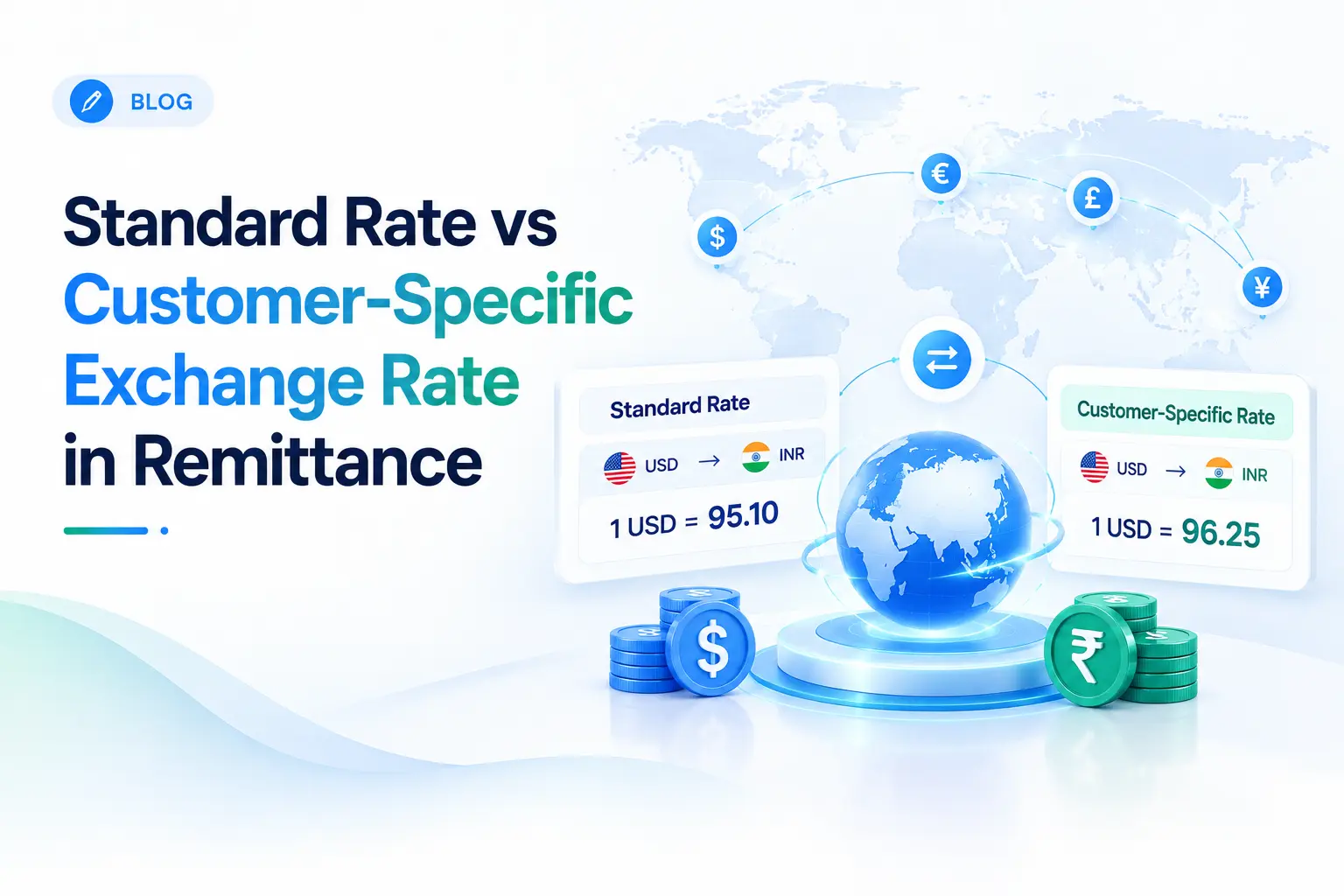
For related context, see how promotional coupons can work in a remittance business and how standard and customer-specific exchange rates differ.
There is no universal answer.
The choice depends on what the campaign is designed to communicate.
The MTO wants a simple, direct monetary benefit that customers can immediately understand.
The exchange rate itself is the strongest part of the customer value proposition, particularly for corridor-focused campaigns.
Which benefit can the MTO define, control and communicate most clearly for the intended campaign?
The decision should also account for the currencies covered, usage limits and campaign duration.
A well-configured promotion is easier to explain to customers and easier for internal teams to manage.
Before launching a remittance promotion, an MTO can work through this sequence:
This sequence completes the campaign setup described above: define the offer and its operating conditions before activating it.
Money-off gives an eligible customer a defined monetary reduction. A better FX rate gives the customer a more favourable exchange rate than the standard rate configured for the eligible transaction.
Money-off can suit a campaign where the MTO wants to communicate a simple, direct monetary benefit that customers can immediately understand.
A better FX rate can suit a campaign where the exchange rate is central to the customer value proposition, particularly for a specific corridor.
Currency pairs differ, so a promotional value should be configured for the applicable currencies rather than assuming one value behaves identically across every corridor.
Define the benefit, audience, value, currencies, permitted usage and campaign period. The MTO should also make the customer-facing conditions clear.
The campaign period defines when the offer is active. Its temporary or limited conditions should also be communicated clearly to customers.
The customer-facing benefit may be a direct monetary saving or a more favourable exchange rate. For the MTO, the useful campaign is the one whose benefit, audience, value, currencies, usage and dates can be clearly defined and communicated.