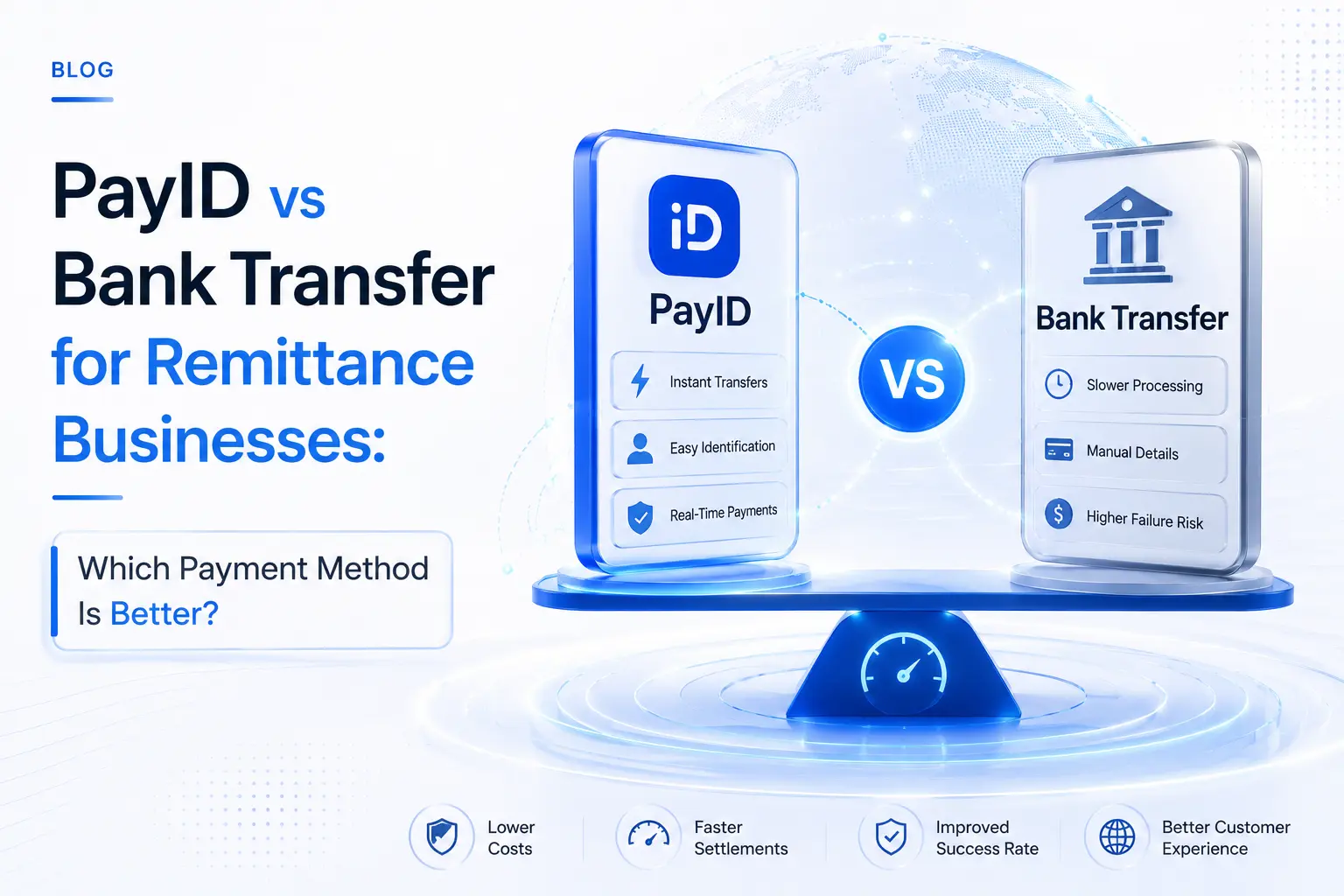
Discover how instant payments can reduce payment friction, improve conversion, support 24/7 remittance experiences, and help MTOs automate payment confirmation and transaction processing.
When a customer starts an international money transfer, every additional step creates an opportunity for them to stop.
A payment that takes hours to confirm can create uncertainty. A payment method that is unavailable on weekends can delay the transaction. A complicated payment flow can cause customers to abandon the transfer before completing it.
For remittance businesses, these aren't simply payment problems. They are conversion problems.
Instant payment infrastructure can address several of these friction points by making funds available faster, supporting 24/7 payment experiences and giving remittance providers better opportunities to automate payment confirmation and transaction processing.
Fast payment systems are increasingly available globally. The World Bank reported in 2026 that people and businesses in 137 countries had access to instant payment services operating on a 24/7 basis.
So, how exactly can instant payments help a remittance business convert more transactions?
Instant payments can improve remittance conversion by reducing payment friction between transaction creation and payment confirmation.
When customers can pay immediately, receive confirmation quickly and complete transactions outside traditional banking windows, there are fewer opportunities for uncertainty and abandonment.
For MTOs, the benefits can extend beyond customer experience to payment reconciliation, transaction processing, liquidity visibility and operational efficiency.
However, instant payments are not a standalone conversion strategy. They work best when integrated into the MTO's broader transaction and payment infrastructure.
In This Article
One of the biggest sources of friction in remittances is waiting.
A customer may create a transaction with the intention of sending money immediately. If the payment confirmation takes hours or requires a banking processing window, the customer is left wondering:
Did my payment go through?
Has the transfer started?
Do I need to do anything else?
That uncertainty can affect the customer experience.
Fast payment systems are designed to make funds available to the beneficiary almost immediately and operate around the clock.
For an MTO, this can shorten the gap between:
Transaction Created → Payment Made → Payment Confirmed → Transfer Processed
The shorter that journey becomes, the less time the customer spends waiting.
Customers rarely abandon a transaction because of one major problem.
More often, abandonment happens because several small points of friction accumulate.
For example:
Instant payment infrastructure can remove some of these waiting points.
Instead of asking customers to wait for a payment to clear, the system can provide a much faster payment experience.
This matters because payment completion is part of conversion.
Getting a customer to create a remittance transaction isn't enough.
The transaction only becomes commercially valuable when the customer actually completes the payment.
International money transfers don't happen only during banking hours.
Customers may want to send money:
A payment system that depends heavily on traditional processing windows can create a mismatch between when customers want to transact and when the payment infrastructure can process the transaction.
Fast payment systems are designed around 24/7 availability.
For an MTO, this creates an opportunity to provide a more consistent payment experience regardless of the time of day.
The customer doesn't have to think:
"I'll finish this transfer tomorrow when the bank is open."
They can complete the payment when they are ready.
Trust is particularly important in remittances because customers are moving money across borders to family members, businesses or other recipients.
A long period without confirmation can create anxiety.
Customers want to know:
Instant payment infrastructure can allow an MTO to provide faster transaction status updates when the underlying payment integration supports real-time notifications.
This creates a more transparent experience:
Payment initiated → Payment received → Transaction updated → Payout initiated
Instead of leaving customers in an ambiguous "waiting for payment" state, the platform can move the transaction forward as payment events are received.
Conversion isn't only a customer-facing problem.
For MTOs, manual reconciliation can also slow down transaction processing.
Consider an MTO receiving hundreds or thousands of customer payments.
If operations teams need to repeatedly check:
then payment processing becomes increasingly dependent on manual intervention.
A properly integrated instant payment system can provide payment events that feed directly into the MTO's transaction infrastructure.
The workflow can become:
Payment received → Payment event → Transaction matched → Status updated → Next workflow triggered
The exact level of automation depends on the payment provider and integration architecture, but the principle is important:
Payment infrastructure should communicate with transaction infrastructure.
Connect payment collection, transaction management, reconciliation, compliance, and payout workflows through a remittance platform built for MTO operations.
Manual payment processes become more expensive as transaction volume increases.
An MTO processing 50 transactions per day may be able to manage certain manual tasks.
An MTO processing thousands of transactions cannot rely on the same operating model.
This is where instant payments become more than a speed feature.
They can become part of an automated payment workflow that reduces unnecessary operational intervention.
For example:
| Traditional Workflow | Automated Instant-Payment Workflow |
|---|---|
| Customer makes payment | Customer makes payment |
| Wait for processing | Payment event received |
| Operations checks payment | System matches transaction |
| Manual status update | Transaction status updated |
| Operations continues processing | Next workflow triggered |
The objective isn't simply to make money move faster. It's to make the entire transaction lifecycle more efficient.
Remittance businesses also need visibility into incoming and outgoing funds.
When payment confirmation is delayed, the MTO may have less immediate visibility into the amount of customer funds that have actually been received and are available for subsequent processing.
Real-time payment infrastructure can provide faster visibility into payment events.
That can help operators make more informed decisions around:
Fast payment systems are increasingly viewed as infrastructure that can accelerate not only payment movement but also information flows around payments. The World Bank's 2026 research specifically discusses the role of fast payments in accelerating liquidity and information.
Payment infrastructure also affects the economics of a remittance business.
The cost of sending remittances remains an important issue globally. The World Bank continues to track remittance pricing across hundreds of international corridors, highlighting the importance of cost and transparency in the market.
A modern payment architecture can potentially reduce some operational overhead associated with payment processing and reconciliation.
But MTOs should be careful about assuming that instant automatically means cheaper.
The cost depends on:
The better strategic approach is to evaluate total payment-processing cost, rather than simply comparing the headline transaction fee.
This is an important distinction.
Adding an instant payment method does not automatically mean an MTO's conversion rate will increase.
Conversion depends on the complete customer journey.
An MTO can have an instant payment rail and still lose customers because:
Therefore, instant payments should be viewed as one component of a frictionless remittance experience.
The goal is to remove friction across the entire transaction lifecycle.
Before adding an instant payment method, MTOs should evaluate more than settlement speed.
A strong integration should consider:
Can the platform automatically receive payment status updates?
Can incoming payments be reliably associated with the correct remittance transaction?
Does the payment rail actually operate continuously for the relevant corridor?
What happens when the amount doesn't match, the payment is duplicated or the transaction cannot be identified?
Can payment records be automatically reconciled with the MTO's transaction ledger?
Can payment events be incorporated into the MTO's existing risk and compliance workflows?
Can the integration handle significantly higher transaction volumes without creating manual operational work?
These questions matter because instant payment infrastructure is only valuable when the rest of the remittance platform can keep up with it.
The global payments landscape is moving toward faster, always-available payment infrastructure.
The World Bank now describes fast payments as systems that provide immediate fund availability and can operate 24/7/365, while noting their growing use across domestic and cross-border payment applications.
For remittance businesses, this shift creates a new expectation.
Customers don't necessarily want to understand the payment infrastructure behind their transfer.
They simply expect:
"I paid. Confirm it. Process my transfer."
That means MTOs need infrastructure capable of turning a payment event into an operational event as quickly as possible.
For an MTO, adding a fast payment method is only the beginning.
The real value comes from connecting payment collection with the rest of the remittance workflow.
A modern remittance platform should connect:
Customer → Payment → Transaction → Compliance → FX → Payout → Reconciliation
When these systems operate together, faster payment infrastructure can contribute to a significantly more efficient transaction lifecycle.
This is the approach RemitSo takes with its MTO-focused infrastructure, combining transaction management, payment workflows, compliance, FX and payout operations in a single platform.
The objective isn't simply to help an MTO process payments faster.
It is to help the operator remove unnecessary friction from the entire remittance journey.
Explore RemitSo's Platform Features →
RemitSo provides a white-label remittance platform designed to connect customer transactions with payment integrations, compliance processes, FX, reconciliation and payout operations.
Instant payments can help remittance businesses address one of the most important conversion problems: friction between transaction creation and payment completion.
By supporting faster settlement, 24/7 availability and more immediate payment confirmation, instant payment infrastructure can create a smoother customer experience and provide opportunities for greater operational automation.
But speed alone isn't enough.
The strongest results come when instant payment capabilities are connected to transaction management, reconciliation, compliance, FX and payout workflows.
For MTOs planning to scale, the question is no longer simply:
"Can we offer instant payments?"
It's:
"Can our entire remittance platform operate at instant-payment speed?"
See how a white-label remittance platform can connect payment collection, transaction processing, compliance, reconciliation, FX and payout workflows in one operational environment.
They can help reduce friction and waiting time during payment completion, which can support better conversion. However, conversion also depends on factors such as pricing, UX, KYC, payment availability and payout speed.
They can provide faster payment confirmation, 24/7 availability and opportunities to automate reconciliation and transaction processing.
They can reduce certain operational costs, but not necessarily the total cost of every transaction. Pricing depends on the payment rail, provider, corridor, volume and commercial arrangement.
Yes. Fast payment systems can support domestic and, where interoperability and appropriate infrastructure exist, cross-border payment use cases. The World Bank identifies both domestic and cross-border applications for fast-payment systems.
MTOs should evaluate payment availability, API capabilities, transaction matching, reconciliation, exception handling, security, compliance and scalability—not just settlement speed.